SIMPLEFLYING
Is LaGuardia More Dangerous Than Other US Airports?
LaGuardia Airport in New York City has been involved in a fatal collision between an Air Canada Express plane and a Port Authority fire truck, killing both pilots and injuring dozens of others, leading to a significant disruption to air travel. The incident has raised questions about whether LaGuardia is more prone to accidents than other US airports. LaGuardia's small footprint and congested layout, which allows for two intersecting runways, may contribute to the perception that the airport is more unforgiving and prone to accidents.
Is LaGuardia More Dangerous Than Other US Airports?
Credit: Shutterstock
By
Paul Hartley
Published Mar 23, 2026, 10:21 AM EDT
Paul has had a career of 25+ years focused on the international technology sector, which has taken him to over 100 countries. Along the way, he developed a deep love for aviation, with a travel bucket list measured by aircraft types flown rather than destinations reached. Now he is bringing that avgeek passion, along with the journalism experience he accumulated early in his career, to write insightful pieces for Simple Flying.
Sign in to your Simple Flying account
LaGuardia Airport (LGA) is back in the headlines for the worst possible reason. Overnight, an Air Canada Express CRJ-900 collided with a Port Authority fire truck while landing at the New York airport, killing both pilots and injuring dozens of others. Reuters has reported 41 injuries so far, including passengers, crew, and two fire-truck officers.
The collision happened as the fire truck was responding to a separate incident involving a United Airlines aircraft, and had been crossing the runway the Air Canada flight was using to land. The crash forced LaGuardia to close until at least 2:00 pm ET on Monday, and triggered more than 500 cancellations, instantly putting one of America’s most scrutinized airports under an even brighter spotlight.
That, in turn, revives a familiar question. LaGuardia often seems to produce outsized aviation drama: runway overruns by the water, winter-weather accidents, a globally famous bird strike incident, and now a fatal ground collision. But does that mean LGA is actually more dangerous than other US airports, or is it simply a more constrained airport where incidents are more visible and more memorable?
New York’s Compact Domestic Workhorse
Credit: Shutterstock
LaGuardia’s role in the US aviation system helps explain why every incident there draws attention. The Port Authority describes it as New York City’s primary business and short-haul airport, and it handled 32.8 million passengers in 2025. That is an enormous volume of traffic for an airport that is not a sprawling hub in the mold of Atlanta, Dallas/Fort Worth, or Denver.
LaGuardia Facts
Detail
Primary role:
New York City’s primary business and short-haul airport
First opened:
December 1939
Annual passengers (2025):
32.8 million
Annual movements (2025):
354,645
Hub for:
American Airlines; Delta Air Lines
Location:
East Elmhurst, Queens
Setting:
Surrounded by Flushing Bay and Bowery Bay
Runway layout:
Two intersecting runways, each 7,002 feet (2,134 meters)
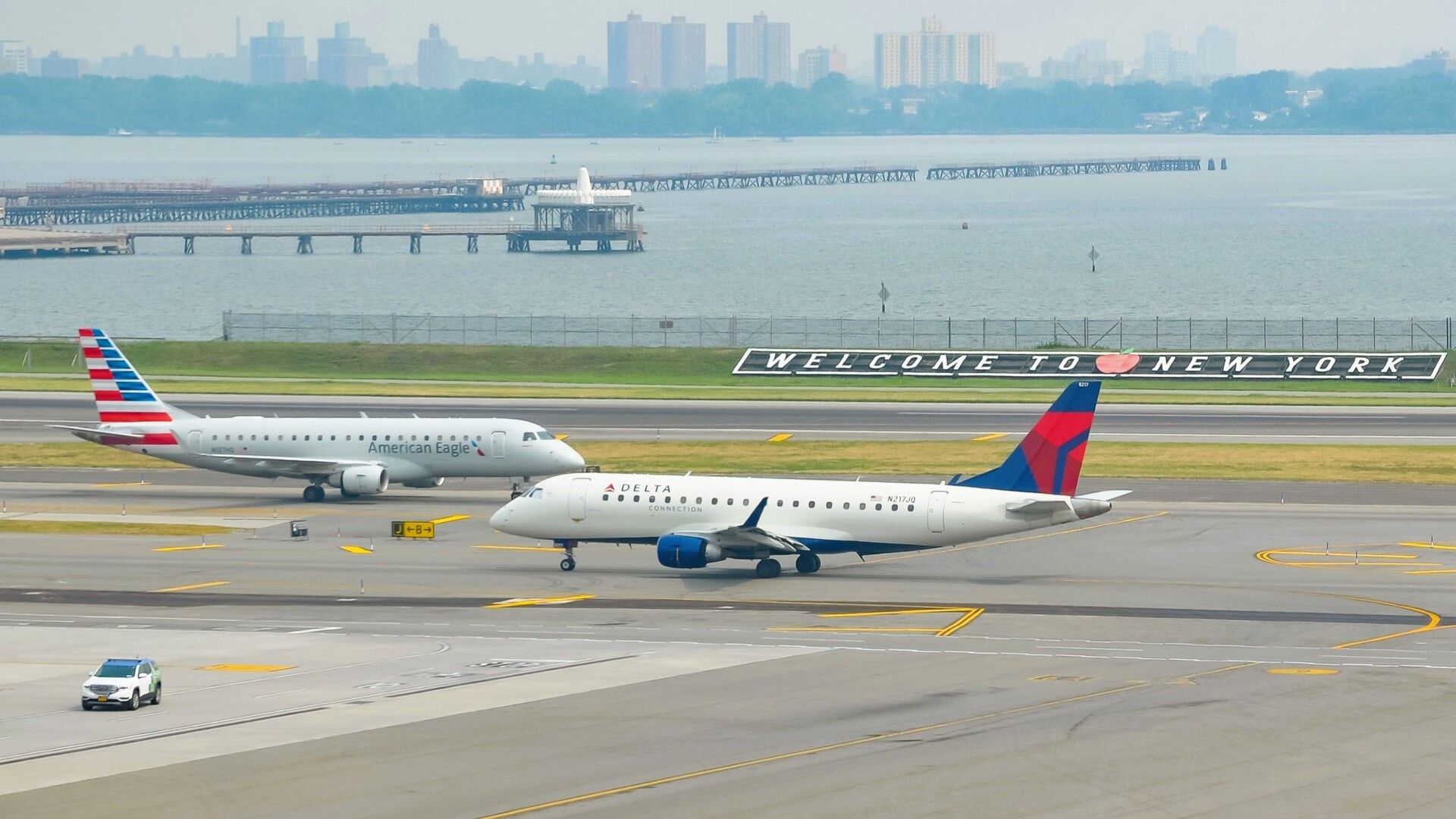
Its physical footprint is part of the story. LaGuardia sits in Queens, close to Midtown Manhattan, on a site bordered by Flushing Bay and Bowery Bay. It is a major airport, being a hub for both American Airlines and Delta Air Lines, but operates on a very tight plot of land — just 680 acres — which is one reason the field has long felt more compressed and less forgiving than many of its peers.
That sense of compression carries through to the airfield itself. LaGuardia’s two main runways intersect, and at 7,002 feet (2,134 meters) each, both are relatively short for such an important commercial airport. In practical terms, LGA is a very busy airport in a small box, and that combination shapes both its reputation and the way incidents there are perceived.
Why LaGuardia Feels Unforgiving
Credit: Shutterstock
The first issue at LGA is runway margin. LaGuardia’s runways are workable for the aircraft types that use them, but they leave less room for error than the much longer runways found at many large US airports. That becomes more important in rain, snow, slush, gusty winds, or any landing where the touchdown point is not ideal. The airport’s history shows that overruns and landing excursions are a recurring theme.
Then there is the water. At many inland airports, an excursion beyond the end of the runway may end in grass or open land. At LaGuardia, the consequences look immediately more serious because there is so little visual and physical buffer beyond the pavement. That geography does not automatically make the airport unsafe, but it absolutely contributes to its unforgiving image.
Challenge
Why it matters at LGA
Shorter runways
Less stopping margin than at many major airports, lLate touchdowns matter more.
Surrounding water
Little buffer beyond runway ends, excursions can become more consequential.
Intersecting runways
Adds operational complexity and requires precise coordination.
Tight surface layout
Busy taxi and runway-crossing environment, ground conflicts can escalate quickly.
Dense New York airspace
Heavy traffic and close sequencing, and weather disruptions tighten margins.
Wildlife exposure
Water-adjacent environment increases bird-strike risk, with Flight 1549 the defining case.
Winter weather
Snow, slush, and ice have featured in major incidents at LGA
The final layer is complexity. LaGuardia combines intersecting runways, a busy surface environment, dense New York-area traffic, wildlife risk, and weather sensitivity. US Airways Flight 1549, or "The Miracle on the Hudson", remains the best-known example of the bird-strike hazard, while the latest Air Canada crash shows that even ground movements at LGA can turn into high-consequence events when things go wrong.
The Incidents That Built LaGuardia’s Reputation
Credit: NTSB
LaGuardia’s incident record is notable because it reflects the airport’s physical environment so clearly. The recurring themes are overruns, winter-weather accidents, approach-and-landing mishaps, ground incidents, and bird strikes. It is less an airport defined by one single pattern of disaster than by a long record of events that underline how little margin the airport appears to offer when operations go awry.
The deadliest accident remains USAir Flight 405 in 1992, when a Fokker F28 crashed after takeoff in icing conditions, killing 27 people. The most famous event, of course, is US Airways Flight 1549 in 2009, which departed LaGuardia, struck birds, lost thrust in both engines, and ditched on the Hudson with all 155 aboard miraculously surviving. More recent cases such as Delta Flight 1086 and Eastern Flight 3452 reinforced the idea of LGA as a place where even survivable events can look dramatic.
Date
Flight
Aircraft
Fatalities
Injuries
What happened
1989
USAir Flight 5050
737-400
2
21
Rejected takeoff and overran into Bowery Bay
1992
USAir Flight 405
Fokker F28
27
21
Crashed after takeoff in icing conditions
1994
Continental Flight 795
MD-82
30
Rejected takeoff overrun after erroneous airspeed indications
1996
Delta Flight 554
MD-88
3
Struck approach lights and runway deck on approach
2009
US Airways Flight 1549
A320-200
5
Dual-engine bird strike after departure; ditching on the Hudson
2015
Delta Flight 1086
MD-88
29
Runway excursion during landing in winter conditions
2016
Eastern Flight 3452
737-700
5
Long touchdown and runway overrun into EMAS
2026
Air Canada Flight 8646
CRJ-900
2
41
Ground collision while landing; under investigation
Note: The final row is based on preliminary reporting and may change as new details emerge.
Now the Air Canada Express crash joins that list, and in a much grimmer way than first appeared overnight. What initially looked like another operational incident has become one of the airport’s most serious modern accidents, both because of the two pilot fatalities and because it involved a runway-crossing ground vehicle at a major US airport.
Related
Delta Connection Bombardier CRJ900s Collide At LaGuardia Airport, Leaving 1 Injured
The incident involved an outbound flight for Roanoke and an inbound flight from Charlotte.
Posts
38
By
Channing Reid
Challenging? Yes. More Dangerous? No
Credit: Shutterstock
Subscribe to the newsletter for deeper LaGuardia insights
Seek clearer context? Subscribe to the newsletter for data-driven coverage and expert analysis of LaGuardia, airport safety, and broader aviation trends—equipping readers with comparative charts, FAA data breakdowns, and in-depth explanations that clarify
Get Updates
By subscribing, you agree to receive newsletter and marketing emails, and accept our Terms of Use and Privacy Policy. You can unsubscribe anytime.
The easiest trap here is to confuse visibility with risk. LaGuardia incidents are often more vivid because its role as a New York airport garners publicity, and the airport’s layout makes them stark: there is water at the ends of the runways, little spare room, and a constant sense of compression. A survivable excursion at another airport can feel routine; at LaGuardia, it can become a national headline.
That does not mean the airport is casually unsafe. Quite the opposite: LaGuardia has long operated with layered safety measures designed for exactly these constraints. For example, FAA materials show runway status lights installed at LGA, and the airport diagram shows Engineered Material Arresting Systems (EMAS) installed at runway ends. EMAS is designed to stop overrunning aircraft by rapidly decelerating them in crushable material, precisely to reduce the consequences of the kind of overrun events LGA is infamous for. The larger point is that the airport’s hazards are well understood, even if they can never be fully eliminated.
So is LaGuardia more dangerous than other US airports? The data certainly doesn't point to this conclusion. For example, the latest FAA data shows that last year LaGuardia recorded 9 runway incursions — the type of event that appears to have happened last night — which is well below airports like Dallas/Fort Worth International Airport (26), Boston Logan International Airport (25), and Chicago O'Hare International Airport (24). That does not prove LGA is “safer” than every peer airport, but it does show it is not standing out as an unusually dangerous outlier in current FAA runway-safety data.
The better answer is that LaGuardia is an airport where constraints are more obvious, consequences are more visible, and incidents can feel more dramatic. That reputation is real. But it is not quite the same as saying LGA is uniquely unsafe. It is more demanding and less forgiving than many peers, but not demonstrably more dangerous in any simple, system-wide sense.
Close
Read original article ↗